Chatbot vs live chat: which one should a small business use?
Insights Getting started 6 min read
Chatbot vs live chat comes down to one question for a small business: is somebody free to answer the chat window right now, at 9 pm, and on Saturday? If yes, live chat is warmer. If no, which is most small businesses, an AI chat assistant that answers from your own information and emails you the conversation is the one that actually catches the lead.

The difference
Both are the same small window in the corner of your website. The difference is what is on the other side of it.
Live chat has a person there: you, your front desk, or a service you pay to type on your behalf. The visitor types, a person answers, and it feels like a conversation because it is one. Its whole value depends on that person being there.
A chatbot answers on its own. The old kind walked visitors through a menu of buttons and gave up at the first real question, which is why the word still makes people wince. The current kind, an AI chat assistant, reads the question, answers in plain language from the information you gave it, and knows what it does not know.
When nobody is free to answer chat
Here is the fact about live chat that the comparison pages written for big support teams never mention: in a small business, the person who would answer it is the same person who answers the phone, checks the patient in, or has their hands in a client's hair.
So the window sits there with a green dot on it, a visitor types "do you take new patients?", and nobody replies for eleven minutes. Then the green dot turns grey and the window offers a form. The visitor, who could have had a form at any time, has now tried to talk to you and been ignored, which is worse than no chat at all.
An assistant answers in the same second every time, and it does not mind the eleventh question about parking. That is a different job from live chat, and it is the job most small businesses have.
Nights and weekends
Look at when your website gets its visitors. For a practice, a salon or a trade, a large share arrive in the evening, after the person searching has finished their own working day, and on the weekend when they finally have time to sort out the thing they have been putting off.
Live chat is off then, unless you pay someone to be on. A chat assistant answers the 9 pm question, takes the booking request, and the enquiry is in your inbox when you open it at 7 am with the visitor's name, what they asked, and what they were told.

When live chat is the better call
If you sell something that is negotiated, custom or emotional, and a person can be at the keyboard during your busiest browsing hours, live chat wins. A design studio, a high-end contractor, a firm whose first conversation is the whole sale. The visitor feels a person leaning in, and that is worth the staffing.
It also wins for a business with an actual front desk that is genuinely free between visitors, and a way to make the window honest when they are not: turn it off, rather than leave it green and unanswered.
When an AI chat assistant is the better call
If the questions repeat, it wins. Hours, prices, whether you take a plan, what to bring, how soon you can come out, whether you do that kind of job. An assistant answers all of them from your own information, the same way every time, and books the visit where it can.
If nobody is free, it wins, for the reasons above. And if the visitor is asking at night or on a Sunday, it is the only option that is awake.
The one condition is honesty about what it is and what it does not know. It should say up front that it is an AI assistant, and when it hits a question outside what you gave it, it should say so and take the visitor's details rather than guess. Our page on what happens when the AI cannot answer is about that moment, because the guess is the failure that costs a lead.
The handoff: getting the lead to you
Whichever you pick, the chat is only useful if the lead ends up with you. Live chat gets you the transcript if you were the one typing. An assistant has to send it.
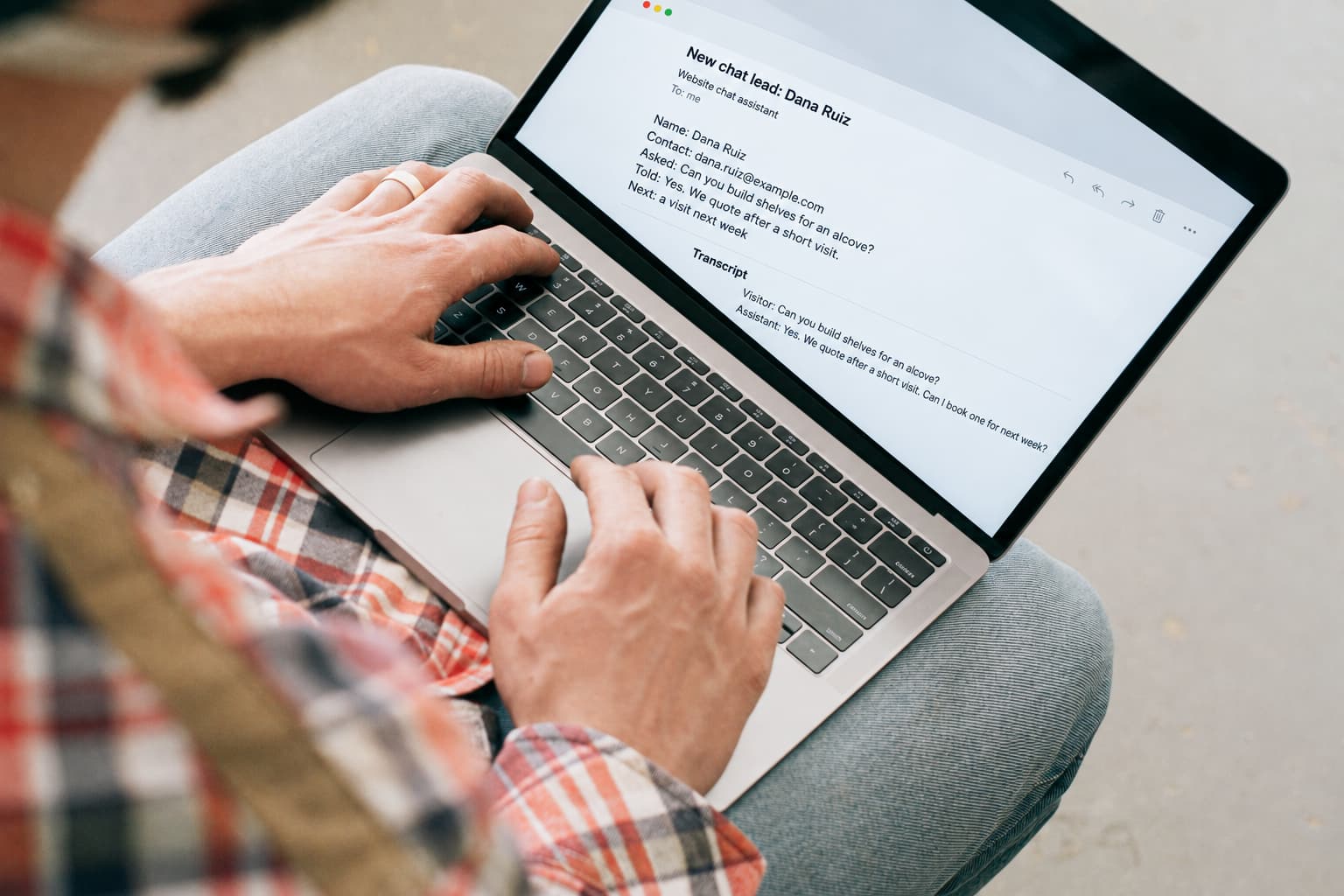
What you want is one email per serious enquiry with the whole conversation in it: the visitor's name and contact, what they asked, what they were told, and what they want next. Not a notification that "someone chatted". Then, if it booked, the booking is already in the calendar with a text confirmation on its way to the visitor. That is how ours works, and the booking half is booking automation.
See it on your own website
The test is the same as for a phone assistant: use it as a customer. Ask the assistant the three questions your front desk answers most, ask one it should not know, and ask to speak to someone. If it answers the three, admits the fourth and hands off the fifth, it will do the job.
Our AI chat widget is one line of code on your site, answers from your own information, and emails you every serious enquiry with the full conversation. If the site itself is the problem, a Smart Website is built with the assistant in it from the start. Either way the plans are side by side on pricing, and the phone version of this comparison is our page on an AI receptionist against an answering service. Salon owners, whose chat window is usually answered by nobody because everybody is with a client, have a page of their own on salon missed calls.
See it answer on your own website
The Reviews + Chat + Booking plan puts an AI chat assistant on your site that answers from your own information, emails you every serious enquiry with the full conversation, and books the job. $397 a month, no contract.
Or just ask us.
Type it or say it. We reply by email or text, usually within one business day.
Trouble loading the form? Email [email protected].
Related questions
- What is the difference between a chatbot and live chat?
- Live chat is a window on your website where a person on your side types replies in real time. A chatbot answers the window automatically. The old chatbots followed a decision tree and frustrated everyone; the current AI chat assistants answer in plain language from the information you give them, which is a different thing with the same name.
- Is live chat worth it for a small business?
- Only if someone can staff it during the hours visitors use it, which are often evenings. A live chat window that shows 'we are away, leave a message' is a contact form with extra steps, and most visitors close it. If you can staff it, it is the warmest option there is.
- Do customers prefer a chatbot or a human?
- They prefer an answer. A visitor at 9 pm asking whether you take a certain insurance plan or how much a cut and colour costs does not care who types the reply; they care that one arrives. Where a person matters, an assistant should say so and hand off, with the whole conversation attached.
- Can a chatbot book appointments?
- An AI chat assistant connected to your calendar can offer open times, take the booking and confirm by text, for the services you have told it to book. Anything that needs your judgment, it takes the details for and passes to you.