Do you have to tell callers they are talking to an AI?
Insights Trust and legal 6 min read
Whether you have to tell callers they are talking to an AI depends on where they are and what the call is for: federal rules reach outbound calls with an AI voice, California's bot law reaches online bots that sell, and Utah requires an answer whenever a consumer asks and a notice up front in regulated work. No rule stops you saying it on every call, and that is what we do.
This explains how the federal ruling and two state laws read, and what we do on our own line. It is not legal advice. Disclosure law is moving, and your state may have added a rule since this was written; ask a lawyer who knows it.
What federal rules say
The belief this page starts from is that telling a caller "you're speaking with an AI" costs you the caller, so the smart move is to say it only where the law forces you to. Both halves of that are wrong, and the second half first.
There is no single federal law that says an AI answering your incoming line must announce itself. What exists at the federal level is the FCC's Declaratory Ruling FCC 24-17, adopted on February 2, 2024 and released on February 8, 2024. It confirms that the Telephone Consumer Protection Act's restrictions on the use of an "artificial or prerecorded voice" encompass current AI technologies that generate human voices.
Read what that reaches. The TCPA restricts calls that are made: robocalls to consumers without their prior express consent. So an AI voice used to call people needs the same consent a recorded message would, and calling without it is illegal. A business whose AI answers the phone when a customer rings in is not making that call. The ruling does not tell it what to say.
State laws that require disclosure
The duties to disclose are in state law, and two states have written them down plainly enough to quote. They cover different things, which is the point.
California's bot law is in the Business and Professions Code. Under section 17941, it is unlawful to "use a bot to communicate or interact with another person in California online, with the intent to mislead the other person about its artificial identity" in order to sell goods or services or influence a vote, and a person using a bot "shall not be liable under this section if the person discloses that it is a bot", clearly and conspicuously. The definitions in section 17940 make "bot" an automated online account and "online" a public-facing website or app. It is a law about website chat and social accounts, not about a phone line.
Utah's is broader and newer. In 2025 the legislature passed S.B. 226, effective May 7, 2025, enacting a section headed "Required disclosures". Two duties. A supplier that uses generative AI to interact with an individual in a consumer transaction "shall disclose to the individual that the individual is interacting with generative artificial intelligence and not a human, if the individual asks or otherwise prompts the supplier about whether artificial intelligence is being used." And a person providing services in a regulated occupation "shall prominently disclose" the AI when the interaction is high risk, which the bill defines to include collecting health, financial or biometric data or giving personalised advice people would rely on for significant decisions; that disclosure is "verbally at the start of a verbal interaction". The same bill adds a safe harbor: no enforcement action against a person whose AI "clearly and conspicuously discloses", at the outset and throughout the interaction, that it is an AI assistant.
So in Utah an AI receptionist for a dentist, a lawyer or an accountant has to say what it is at the start of the call, and any Utah business's assistant has to answer honestly the moment a caller asks. Other states have bills in various stages, and this page will not list ones we have not read. The safe harbor is the tell: saying it up front, on every call, is the setup every one of these laws rewards.

Disclosure and recording are two different notices
Owners often fold the two together, and they are separate facts with separate laws behind them.
Recording law is about consent to being recorded, and in the all-party states everyone on the call has to agree before it starts. Our article on whether it is legal to record calls with an AI receptionist covers that, and the Florida call recording law page is the worked example. AI disclosure is about who, or what, the caller is talking to. A call can be recorded by a person, or answered by an AI and not recorded, and each of those needs a different notice.
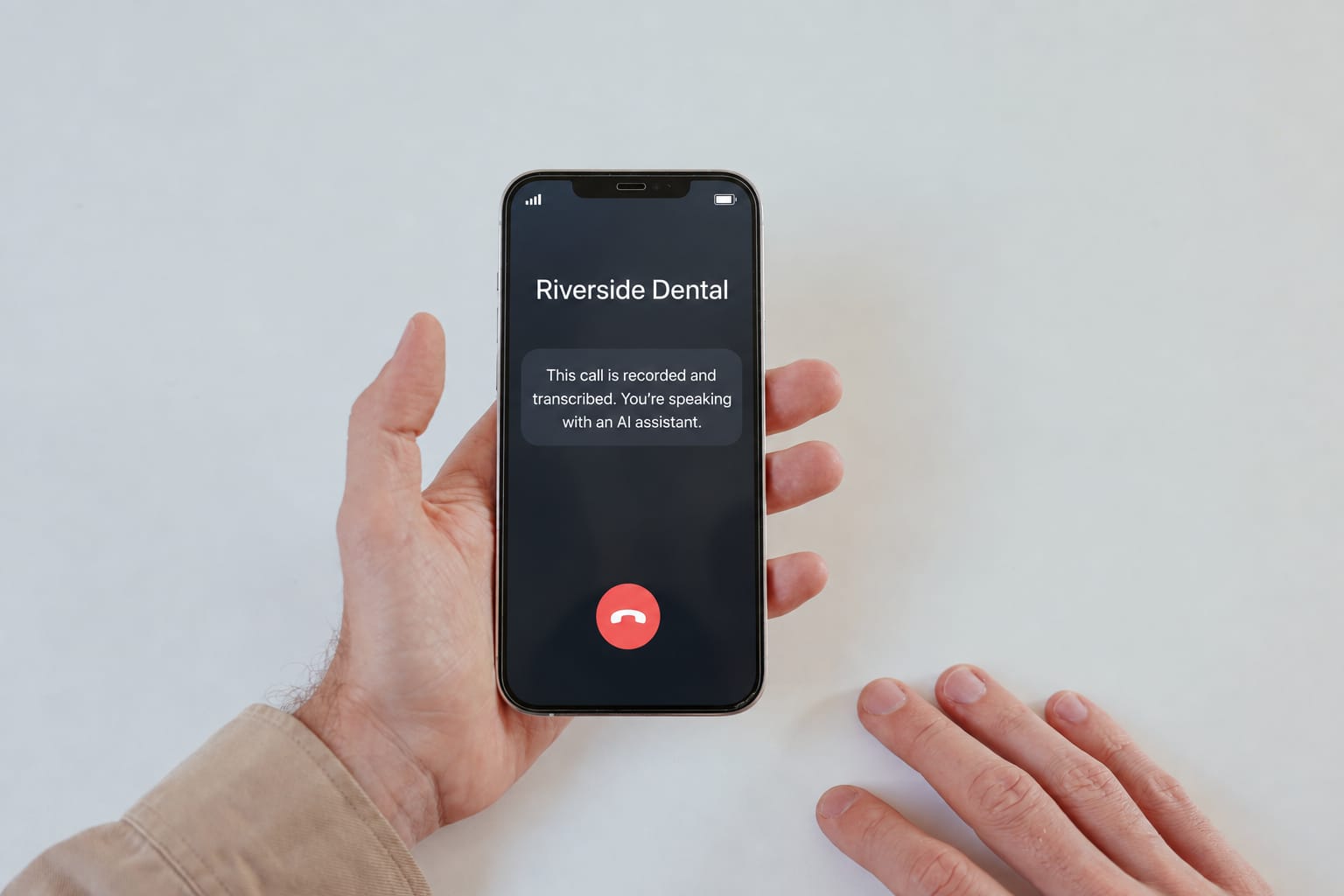
Most AI receptionists do both: they record or transcribe the call to answer it and to send you the summary, and they are AI. So the notice has two clauses, and a caller needs to hear both before the assistant does anything else.

How to say it without losing the caller
Now the first half of the belief: that the disclosure costs you the caller. Callers hang up on being stuck, not on being told. Our page on whether callers hang up on an AI receptionist goes through what actually makes them leave, and disclosure is not on the list when it is done like this:
- First, before anything else. A disclosure discovered halfway through feels like a trick, and that is when people leave.
- Plain words. "You're speaking with an AI assistant." Not "an automated virtual agent experience".
- Both facts if both are true: recorded and transcribed, and an AI assistant.
- Then straight to "how can I help?" The greeting is over in two sentences.
- The same words on every call, so you can say exactly what every caller heard.
- A way to a person, offered early, for the callers who want one.
Whether the voice gives it away anyway is a different question, and our article on whether an AI receptionist sounds human answers it: usually a little, and it usually does not matter once the caller has been told.
What we do on every call
We do not try to work out which state a caller is in or which law applies to the call. Every call, including our own line, opens with the same recorded notice before the assistant can say a word: the call is recorded and transcribed, and the caller is speaking with an AI assistant. It is identical on every call, a custom greeting cannot replace it, and the business that uses our AI receptionist cannot switch it off. Our website chat assistant says the same thing in text before a conversation starts.
The wording, what we keep and for how long, and how a caller reaches a person are on our trust page, and the terms that bind us to it are the AI terms. If you are comparing providers, ask each one the two questions this page comes down to: does the notice play first on every call, and can anyone turn it off? If the answer to the second is yes, the risk under every law above is yours.
Hear the notice before you trust it
Call (888) 997-6457. Our own line says it is an AI assistant, and that the call is recorded and transcribed, before the assistant says anything else, exactly the way it does for the businesses we set up.
Or just ask us.
Type it or say it. We reply by email or text, usually within one business day.
Trouble loading the form? Email [email protected].
Related questions
- Is it illegal not to disclose AI on a phone call?
- There is no single federal rule that says an inbound call answered by an AI must announce itself. The FCC's 2024 ruling covers calls made with an AI-generated voice under the robocall rules. State law is where the duties live, and they differ: California's applies to online bots that sell or influence votes, Utah's requires a truthful answer when a consumer asks and an up-front notice in regulated work. Ask a lawyer about your state and your callers' states; and saying it on every call is allowed everywhere.
- Does the FCC AI ruling apply to an AI receptionist answering calls?
- The ruling confirms that the TCPA's restrictions on artificial or prerecorded voices include AI-generated voices, and the TCPA restricts calls that are made, such as robocalls to consumers without their prior consent. It does not create a disclosure rule for a business answering its own incoming line. It does mean an AI voice used for outbound calling needs the same consent a recorded message would.
- Do you have to disclose an AI chatbot on a website?
- In California, if the bot interacts with a person online with the intent to mislead them about being artificial in order to sell something or influence a vote, the law treats it as unlawful unless the bot discloses that it is a bot, clearly and conspicuously. The simple way to stay clear of that is to have the chat say it is an AI assistant before the conversation starts, which is what ours does.
- What should an AI disclosure say?
- Plain words, said first, and the same every time: that the caller is speaking with an AI assistant. If the call is also recorded or transcribed, say that too, as a separate fact. Then move straight to the question, because the disclosure that loses callers is the one buried in a long greeting.