Florida call recording law: what a business needs to know
Insights Trust and legal 5 min read
Florida call recording law requires everyone on the call to consent before it is recorded, so a business has to tell every caller first. That is stricter than federal law, and recording without that consent is a felony that also gives the caller a claim for damages.

This explains how Florida's statute reads and how we handle it on our own line. It is not legal advice. If a recording could end up in a dispute, ask a Florida lawyer.
Florida is an all-party consent state
Federal law lets you record a call as long as one person on it agrees, and that person can be you. That is the one-party rule in 18 U.S.C. 2511(2)(d).
Florida does not. Under section 934.03(2)(d) of the Florida Statutes, recording a call is lawful when "all of the parties to the communication have given prior consent."
Two words in that line do the work. "All" means the caller, not just you and your staff. "Prior" means before the recording starts, not halfway through the call when somebody remembers.

What counts as recording under the statute
The statute does not say record. It says intercept, and section 934.02(3) defines that as the "aural or other acquisition of the contents" of a call through an electronic, mechanical or other device.
That reaches further than a tape. A call recorder counts. So does software that captures a call to write a transcript, because a transcript is the contents of the call in text. If a tool keeps the words, treat it the way you would treat a recording.
What it means on a business phone line
Think about a normal week of calls. A homeowner with no cooling. A patient moving an appointment. A supplier. Someone in Ohio calling about a job at their mother's house in Sarasota.
You cannot see where any of them are, and an area code only tells you where a number was issued. That is why our broader answer on whether it is legal to record calls with an AI receptionist treats the "which state am I in" question as a trap. If your line records anything, every caller hears a notice before it starts.
The same goes for calls you make. A callback from your cell to a customer has two parties, and both need to know if it is being recorded. And it covers whatever answers when you cannot: an answering service, a call-tracking number, after-hours call answering or an AI receptionist. If it records or transcribes, the notice comes first.
What your recording notice should say
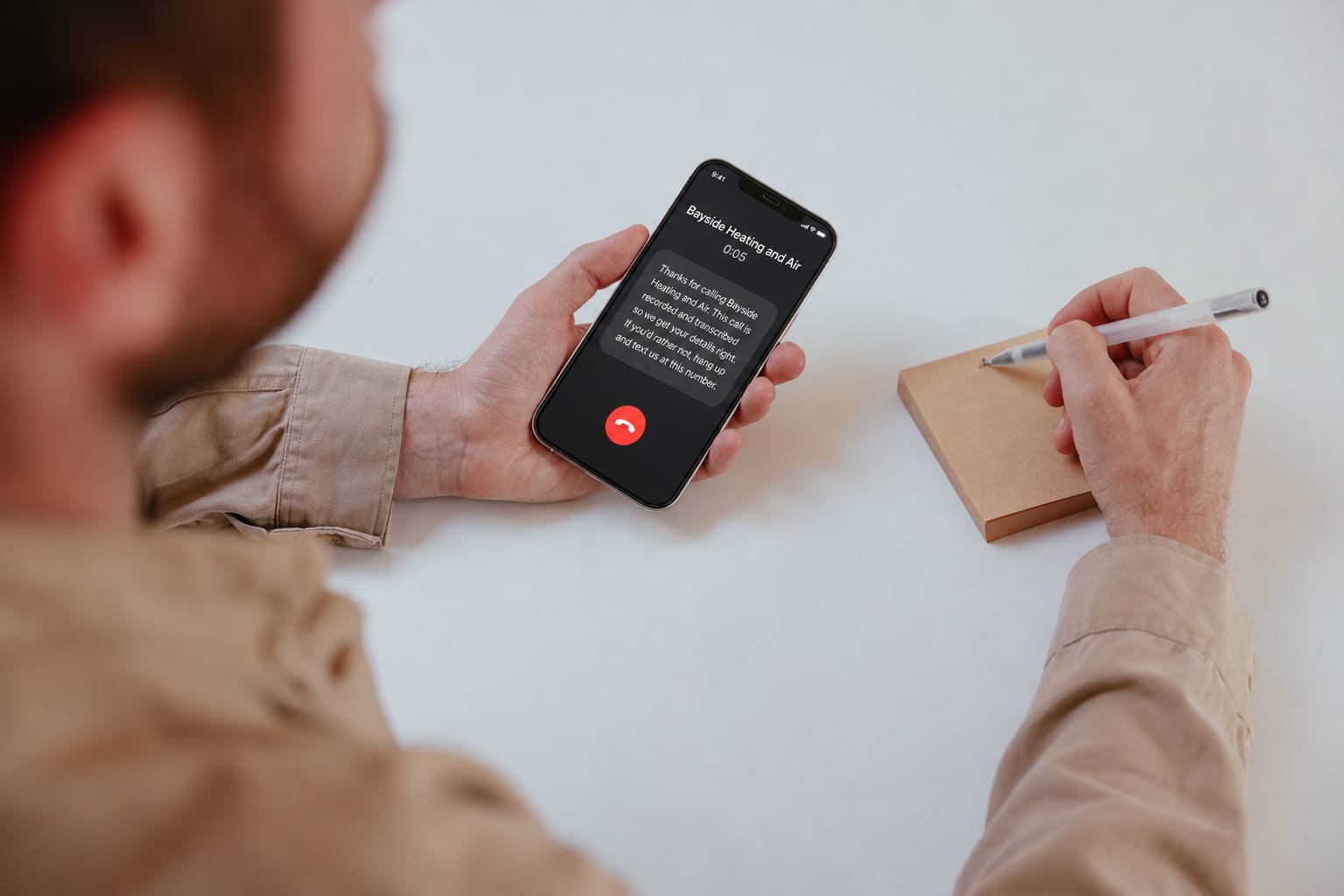
Keep it short and play it at the very start of the call, before anyone speaks. A caller should understand it the first time they hear it. It needs three things:
- That the call is recorded, and transcribed if it is.
- Who is recording it, which is your business.
- What the caller can do instead, such as hang up and text you.
A version that works on most business lines:
"Thanks for calling [your business name]. This call is recorded and transcribed so we get your details right. If you'd rather not, hang up and text us at this number."
If an AI assistant answers, say so in the same notice. Then keep the wording identical on every call, so you can say exactly what every caller heard if the question ever comes up.
What happens if you get it wrong
Florida treats this as a crime, not a paperwork slip. Recording a call without everyone's consent is a felony of the third degree under section 934.03(4)(a).
It is also a lawsuit. Under section 934.10, the person recorded can recover actual damages of at least $100 a day for each day of violation or $1,000, whichever is higher, plus punitive damages and a reasonable attorney's fee. They have two years from when they first had a reasonable chance to find out.
For a business that records every call the same way, the exposure is not one call. It is every call made that way.
Recording a conversation in person
The statute also covers face-to-face conversations, but only where the person speaking expects not to be recorded and that expectation is justified. That test sits in the definition of "oral communication" in section 934.02(2).
A quick exchange at a busy front counter is not the same as a private talk in a closed office. If you run cameras that pick up audio, ask your lawyer how that test applies to your space before you rely on the footage.
AI receptionists and call transcripts
An AI receptionist raises the same question as any recorder. It has to hear the call to answer it, and most keep a transcript so you can check what was said and promised.
We are a Tampa company, so this is the rule we work under. On every call, including our own line, a recorded notice plays before the assistant can say anything: the call is recorded and transcribed, and the caller is speaking with an AI assistant. It is identical on every call, a custom greeting cannot replace it, and we keep the transcript, not the audio. The details are on our trust page.
If you are weighing an AI receptionist for your business, ask any provider two questions. Does the notice play before the first word of the call? And can anyone switch it off? If the answer to the second is yes, you are the one carrying the risk. Callers mostly care about something else anyway, which is whether an AI receptionist sounds human enough to talk to.
Hear the notice before you trust it
Call (888) 997-6457. Our own line plays the recording and AI notice before the assistant says a word, exactly the way it does for the businesses we set up.
Or just ask us.
Type it or say it. We reply by email or text, usually within one business day.
Trouble loading the form? Email [email protected].
Related questions
- Is Florida a two-party consent state?
- Yes. The statute says all parties rather than two, in section 934.03(2)(d), so on a three-way call all three people have to consent. People say two-party because most calls have two people on them.
- Is it legal to record a phone call in Florida without the other person knowing?
- No. Recording a call without the prior consent of everyone on it is a third-degree felony under section 934.03(4)(a), and section 934.10 lets the person recorded sue for damages and attorney's fees.
- Does a "this call may be recorded" message count as consent in Florida?
- It is how businesses ask for consent: the caller hears it before anything is recorded and can hang up. Whether a particular notice holds up in a dispute is a question for a Florida lawyer, which is why the wording should be plain and the notice should play first, on every call.
- What about calls between Florida and another state?
- Federal law only asks for one party's consent, and the other state may too. You usually cannot tell where a caller is sitting, so the simple approach is to treat every call as if the all-party rule applies.